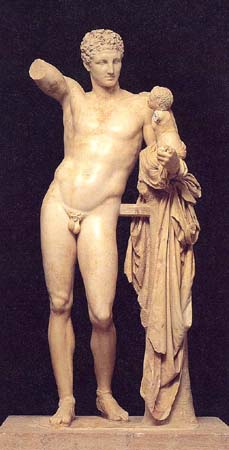
Praxiteles,
c. 350 BC
Hermes with the infant Dionysus
Olympia
Hermes with the infant Dionysus
Olympia
The
Greek Spirit
by John Lauritsen
Service conducted by John Lauritsen at the UU Meeting House in Provincetown, 23 May 1999.
Opening Words
In this Meeting House people of different faiths and different outlooks come together in fellowship.
In my mini-sermon last March I compared the Unitarian Universalist model to a “theological smorgasbord”. Perhaps a better comparison would be to the Pantheon in Rome, a temple dedicated to all of the gods.
This building is a fine example of Greek Revival architecture. So it is an appropriate place for another kind of Greek Revival: the Olympian religion, the gods of Homer. I'll briefly introduce what Walter Pater called the “graceful polytheism” of Ancient Greece.
Sermon
Intellectually I am a Freethinker or a Secular Humanist. But in my heart I am a Pagan, one who reveres the ideals and gods of ancient Greece.
I've been in love with Greece all my life. As a small boy I was entranced by the Greek myths, and read every book I could find on them. I became keen on Astronomy, and learned the constellations, so I could see my heroes up in the sky.
In junior high school I read the Iliad, in a prose translation. I was thrilled by the battle scenes — laughed over the antics of the Olympian gods and wept over the death of Patroklos.
In my freshman year at college I studied Ancient Philosophy under Raphael Demos, a great Plato scholar and a great teacher. The reading list was simple: all of Plato's dialogues, the major works of Aristotle, and Lucretius' De Rerum Natura. In my sophomore year I took a course on The Classical Tradition in Western Art, which in addition to architecture studied a lot of male nudes. On the side I read John Addington Symonds' A Problem in Greek Ethics, which is still, more than a century after it was written, the best treatment of male love in ancient Greece.
Oddly, I felt as though I were coming home. The world of the Greeks almost three millennia ago seemed far more natural and congenial to me than the United States of the mid-20th century.
The philosophical, political, scientific, legal, and artistic foundations of Western Civilization were erected in Athens. We pay tribute to Greek ideals: respect for the freedom of the individual, the pursuit of physical and intellectual excellence, and so on.
But Greek religion is not taken seriously. We have a cultural prejudice against polytheism. Greek religion lacks those properties found in Christianity and other religions that originated in Asia Minor. And Greek religion contains humor, which seems inappropriate.
Some think of Greek religion in terms of the Mystery cults, like the Eleusinian. However, little is known about them. Millions of people were initiated into the mysteries, but the specifics of the services are unknown. They remain mysteries. It was said that after initiation into the Eleusinian mysteries, one was no longer afraid of death.
A different approach — that of Walter Otto in his splendid book, The Homeric Gods — is to take the Olympian deities seriously. I do, and shall now introduce them, although I'm sure they're here already. I'd expect the Olympians to be popular in Provincetown, as they are eternally young and beautiful, and they have charm. As I'm not sure of the exact order of precedence, I'll describe them in alphabetical order.
APHRODITE (aph ro dye' tee)
Daughter of Zeus. Goddess of Love. She presides especially over seduction, sexuality, and procreation.
APOLLO
Son of Zeus. God of reason, moderation, light, healing, purification, prophesy, music, poetry. When a man's time is up, the time allotted him by the Fates, he is slain by Apollo, who deals death from far away.
ARES (air eez)
Son of Zeus and Hera. God of War. He is disliked by some of the other gods, but Aphrodite is keen on him.
ARTEMIS
Daughter of Zeus. Goddess of the Hunt. Of chastity. Lady of Wild Beasts. The goddess that roves by night. Protector of women in childbirth. A counterpart of her brother Apollo, she slays women from far away when their time is up.
ATHENA
Daughter of Zeus. Goddess of War and of Wisdom. A serious goddess, her salient attribute is good common sense. Although a virgin, she is friendly to men and a good goddess to have on your side.
DEMETER (di meet' r)
Daughter of Cronus and Rhea. Goddess of the harvest. Mother of Proserpina (pro serp' in a), Queen of the Underworld.
DIONYSUS (dye o nye' sus)
God of wine and intoxication, of ritual madness and ecstasy, of theater.
HEPHAESTUS (hi fest' es)
The crippled son of Hera. God of fire, of blacksmiths and artisans. Married to Aphrodite, but cuckolded by Ares.
HERA (Hir' a)
Queen of the gods. Daughter of Cronus; sister and wife of Zeus. Exemplar of marriage and royalty.
HERMES (Her' meez)
Son of Zeus. A god who is friendly, playful, and mysterious. Messenger of the gods. God of commerce, music, medicine, eloquence. Protector of travellers, scholars, shepherds, and thieves. When someone dies, Hermes takes him by the hand and escorts him to the Underworld.
POSEIDON (Po sye' dn)
Brother of Zeus. God of the sea, earthquakes, and horses.
ZEUS (zoos)
The most powerful Greek god. Known as “Father Zeus”, “The Thunderer” and “All-seeing Zeus”. A god of justice. A defender of kings, but also of strangers, suppliants, and beggars.
These twelve comprise the Olympian family, the gods of Homer, who first appear (in surviving literature) in the Iliad, the Odyssey, and the Homeric hymns — about 28 centuries ago. In years following — in poetry, philosophy, drama, and art — each of them acquired additional attributes and functions, but retained essentially the same personality.
Greek religion is natural and objective. It is consonant with the Greek spirit: noble, clear, simple, strong, straightforward. It is opposed to everything that is cheap, affected, muddled or weak.
In Greek religion there is a remarkable absence of magic words, magic gestures, empty rituals, exotic and showy priestly robes, or hypnotic elements.
When a Christian prays, he does so on bended knees, with head bowed and eyes closed. The attitude is one of submission, as before an Oriental despot.
In contrast, when an ancient Greek prays, he does so with head upraised to the sky and arms uplifted. The attitude is one of pride, joy and alertness — at the same time, with reverence to the deity.
Greek prayers get to the point. The Trojan women pray to Athena to help them. Athena hears their prayer and refuses it.
Achilles prays to Father Zeus that his friend and lover, Patroklos, may do glorious deeds in battle and then return safely to camp. Zeus hears the prayer; he grants the first half and refuses the second.
Greek gods have a characteristic way of intervening in human affairs. In the beginning of the Iliad, Achilles is in a rage. He has been gravely offended and his honor is at stake. Unless he can check his anger he will kill Agamemnon, the commander-in-chief of the Greek forces. At that moment Athena soars down from heaven, and seizes Achilles by his golden hair. With eyes blazing Athena commands him to check his temper, and promises him generous rewards to make up for the insult. Achilles obeys, and thrusts his sword back in its sheath. No one but Achilles has seen the goddess.
I'll tell an episode from my own experience. Many years ago I visited Sparta. On the outskirts of town, on a mountainside, is Mystra, an ancient Byzantine city, remarkably preserved. By the end of the afternoon I reached the topmost part of Mystra, and came to a narrow path leading up the mountainside to a citadel on the top. No other tourists went up the path, but I did. As I was getting near the top I was seized by an attack of vertigo. I looked over the side and was terrified to see that it was a sheer drop for several hundred yards. Normally I'm not afraid of heights; in fact, I enjoy them. But then I was helpless. Before leaving Sparta I had eaten a dessert full of honey, and this apparently was causing an attack of hypoglycemia. My legs wouldn't support me. I sat down, my back against the mountainside, clutching a bush for support. I sat there for a long time, not knowing what to do. Then I prayed to Hermes, protector of travellers. Immediately the god manifested himself — in the form of a couple of tourists, who came bounding up the path. Middle-aged, plump and jolly, they were certainly not afraid. I explained my predicament. Since they were German they assumed that I, having gone that far, would want to climb to the top, and they offered to hold my hands. As soon as we started up, the man ahead of me and the woman behind, the dizziness vanished. I stayed for a long time in the citadel. The view was awesome. And when I went down alone, my legs were steady.
So you see, the old gods still answer prayers.
And the Greek gods will live, as long as there exist: nature, humanity, and people with a classical education.
How do we worship them? The question really gets down to: How do we live? John Addington Symonds suggests that we follow the Greeks by being “natural”. In The Greek Poets he writes:
Some will always be found ... to whom Greece is a lost fatherland, and who, passing through youth with homesickness for that irrecoverable land upon them, may be compared to visionaries, spending the nights in golden dreams and the days in common duties. Has then the modern man no method for making the Hellenic tradition vital instead of dream-like — invigorating instead of enervating? There is indeed this one way only — to be natural: we must imitate the Greeks, not by trying to reproduce their modes of life and feeling, but by approximating to their free and fearless attitude of mind. To do this in the midst of our conventionalities and prejudices, our interminglement of unproved hopes and unrefuted terrors, is no doubt hard. Yet if we fail of this, we lose the best the Greeks can teach us.Goethe expresses the Hellenic ideal in a couplet:
Im Ganzen, Guten, Schönen
Resolut zu leben
(To live with steady purpose in the Whole, the Good, the Beautiful.)
Our universities, when they were closer to the classical ideal, emphasized the “pursuit of excellence”, both physical and intellectual.
Hellenism is not for everybody. But for those who are sympathetic, I suggest three things:
1. Learn more about our classical heritage. A visit to the classical collection of the Boston Museum. Reading the Iliad and Odyssey, the dialogues of Plato, the great tragedies.
2. Pursue excellence by making the best of ourselves.
3. In the phrase of the Hellenist philosopher, Nietzsche: “Say YES to life.”
We will now have a moment of silent reflection.
Prayer
I'm going to read a philosopher's prayer. It was given by Socrates at the end of Phaedrus, one of Plato's two great dialogues on Love. And remember, this is a pagan prayer, so it's all right to keep the eyes open.
On a hot summer day Socrates and his friend Phaedrus have walked into the country on the outskirts of Athens. By the riverbank, in the shade of a large plane tree, they discuss rhetoric, truth, and the willing constraints of Love. This dialogue has one of the most profound and famous symbols in literature, that of the Charioteer. On the left of the chariot is the unruly dark horse of passion and sensuality; on the right is the noble light horse of modesty and reason. Both are commanded by Love as the Charioteer of Souls.
Towards evening the heat has begun to let up, and Socrates and Phaedrus decide to return to Athens. The dialogue concludes:
SOCRATES: Should we not offer up a prayer first of all to the local deities?
PHAEDRUS: By all means.
SOCRATES: Beloved Pan, and all ye other gods who haunt this place, give me beauty in the inward soul; and may the outward and inward man be at one. May I reckon the wise to be the wealthy, and may I have such a quantity of gold as a temperate man and he only can bear and carry. — Anything more? The prayer, I think, is enough for me.
PHAEDRUS: Ask the same for me, for friends should have all things in common.
SOCRATES: Let us go.