
We all savor that instant when a scene reads like it was penned in another century.
Yet the illusion shatters the moment an AI slips a “2020s” phrase into 1851 London.
Researchers recently confirmed what many authors suspected: even today’s largest language models leak modern idioms into historical prose, mistaking “Dickens” for “blog” writing.
AI isn’t worthless for historical fiction—it simply demands sharper oversight. We have to choose our partners carefully, pressure-test them, and keep the quill firmly in our hands.
This guide spotlights seven AI tools that passed a brutally simple test: stay true to the period, deepen the detail, and leave you in charge of the narrative. You’ll see where each one excels, where it stumbles, and how it matches different writing budgets.
Step onto the cobblestones with us and find the AI co-writer that preserves your story’s authenticity while letting you write faster.
Why Historical Fiction Pushes AI to Its Limits
Historical fiction offers no mercy. Introduce a smartphone into Victorian London and readers close the book.
That vigilance makes the genre a brutal test for any writing algorithm. An AI must juggle period vocabulary, social norms, and real events while still driving a compelling plot.
The challenge starts with language. A recent study showed that large models drift toward modern phrasing even after researchers fed them nineteenth-century text. “Blog voice” sneaks in unless we patrol every line.
Next comes factual weight. Your plot might hinge on the Crystal Palace opening in 1851; if the AI recalls the date as 1850, the timeline collapses. General chatbots hold plenty of data, but they also invent with confidence.
Finally, there’s endurance. Novels run tens of thousands of words. Most models forget key details long before chapter three, resurrecting dead characters or shifting accents mid-scene.
Together, these pressures expose weak spots fast. That’s why the tools we’re about to explore made the list: they respect authenticity, accuracy, and memory better than the rest.
How We Tested Every AI on This List
We wanted proof, not press-release promises. So we put every tool through the same tough test.
First, we wrote a 300-word scene prompt set in 1851 London. It introduced two characters, hinted at the Great Exhibition, and set one rule: no modern references.
Each platform had to continue the story for about one thousand words, then extend the plot in a second chapter. That length forces an AI to recall earlier details instead of starting fresh each time.
After generation, we performed a line-by-line review for anachronisms, wrong facts, and continuity slips. If a model mentioned telephones or swapped a surname midway, it lost points immediately.
Finally, we scored every tool across seven weighted factors, with period accuracy counting double. Two team members graded blind, compared notes, and resolved any ties word by word.
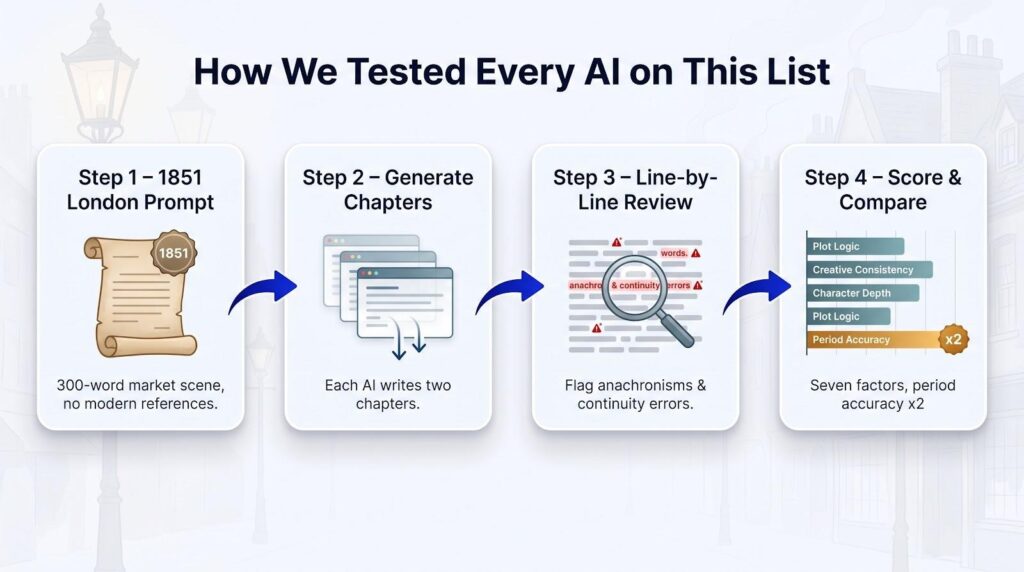
The result is a dataset of wins and misses you can trust, with zero marketing gloss.
1. DreamGen – The Immersion Specialist
DreamGen topped our score sheet for one simple reason: it never once broke the illusion of 1851. With more than 1 million registered users and an active Discord community of 5,000+, this independently run, self-funded platform has grown into a favorite among fiction writers.
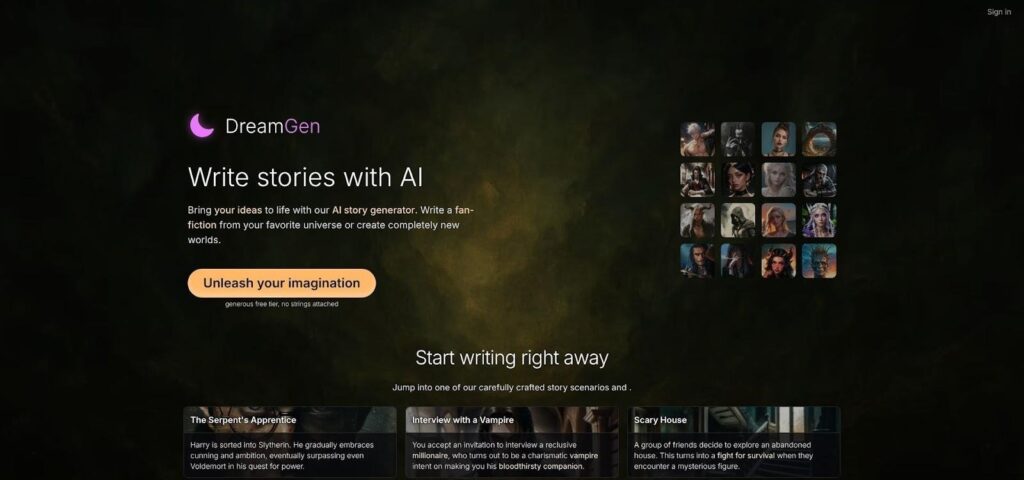
DreamGen story writing interface with scenarios for historical fiction
When we fed it our London marketplace prompt, the prose flowed in crisp Victorian cadence, filled with gas-lamp glow and clattering hansom cabs. Not a single modern slip crept in, even after the second-chapter continuation.
That advantage is documented in DreamGen’s 2025 head-to-head benchmark of ten story generators (https://dreamgen.com/blog/articles/best-ai-story-generators), where its Scenario system claims top marks for weaving saved lore into new prose. Think of it as a living story bible beside your draft. We loaded a private scenario with a few period notes (Great Exhibition dates, slang like “copper” for a constable) and watched its flagship GLM 4.7 model weave those details into dialogue without further prompting. (Note: DreamGen allows both SFW and NSFW content, but its public scenario library is SFW, so keep grittier themes private.)
Long memory also matters. On the Pro plan, DreamGen keeps up to thirty-thousand tokens in view (compared with 5,000 on the free tier), so side characters stay consistent and subplots don’t vanish when you turn the page.
Pricing is straightforward. The free tier provides roughly 2,000 role-play messages per month on its Lucid Base model (plus about 250 daily messages after monthly credits and roughly 150 images). The Pro subscription unlocks unlimited first-party models, a 60 percent discount on third-party models (such as GLM 5 and DeepSeek 3.2), and a 20 percent discount on credit packs.
The only learning curve is the interface. You’ll spend an afternoon organising your Scenarios and toggling between Role-play and Story modes on the mobile-optimised website (there is no dedicated mobile app). Do that once, and the tool feels like a well-briefed co-author who never forgets the brief.
If your top priority is airtight period accuracy wrapped in flexible creative control, start your trials here.
2. Sudowrite – Your In-House Plot Coach
Sudowrite makes blank pages vanish by turning rough ideas into structured scenes in minutes.
Open the Story Engine, sketch three beats, and the AI expands each into vivid paragraphs filled with coal smoke, clinking shillings, and the tinny rattle of a hurdy-gurdy. Its Describe and Rewrite tools act like instant polish: highlight a dull line, click, and watch it bloom into multisensory prose without losing period flavor.
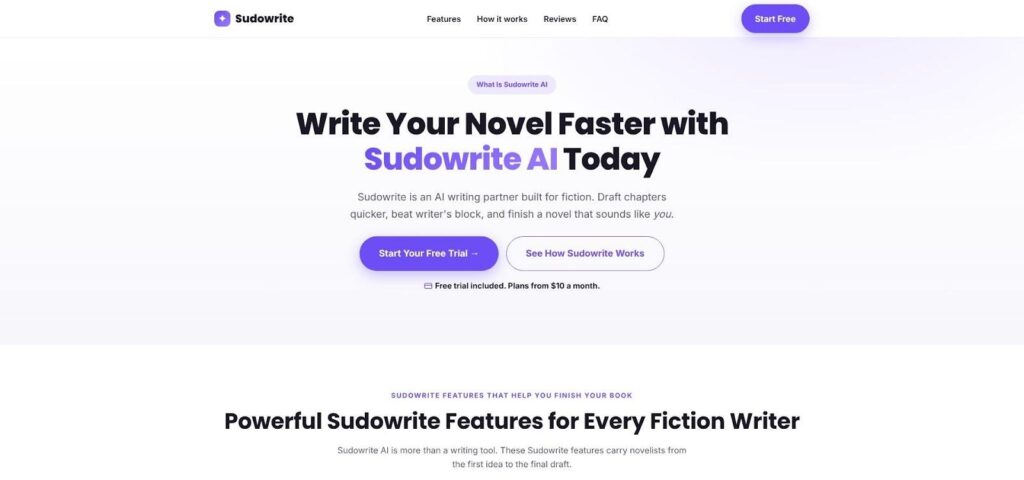
Sudowrite Story Engine and rewrite tools for plotting historical fiction
We did catch the occasional modernism, such as an “okay” in dialogue, but the fix was painless. Select the sentence, hit Rewrite, and it converts to “Right then, let us be off,” as though a quick-thinking editor sat beside you.
Sudowrite’s true edge is momentum. If you wrestle with pacing or scene goals, the tool nudges you forward, suggesting conflicts, cliff-hangers, and fresh descriptions in seconds.
The trade-off is price. Unlimited drafting sits behind a professional tier that costs more than a typical streaming bundle. Many writers keep a month’s subscription on standby for kickoff sprints and stubborn chapters when the human brain needs a boost.
3. ChatGPT (GPT-4) – The Encyclopedic Brain
When you need historical depth on demand, ChatGPT is the workhorse.
Ask for the price of a postage stamp in 1851, and it returns a figure, context, and a period quote before you finish your coffee. That breadth makes it a dependable research sidekick while you draft.
ChatGPT GPT-4 interface used as a historical research sidekick
During our scene test, GPT-4 slipped in the Crystal Palace, street vendors hawking “hot pies, penny a slice,” and even Lord John Russell’s ministry. The knowledge felt natural, not forced.
Accuracy still needs vigilance. Left unguided, the model slipped a “million-dollar question” into a cobbler’s dialogue, a modern idiom in disguise. One follow-up prompt fixed it, but you have to stay alert.
Long-form coherence shines for a chapter or two, yet the 8-thousand-token memory fades sooner than DreamGen’s larger window. Split novels into smaller threads or summarise earlier chapters to keep it steady.
At twenty dollars a month, ChatGPT Plus delivers up to 160 GPT-4 messages every three hours, plugins, and a browsing toggle for mid-draft fact checks. That value is hard to match if you can babysit the style.
Use it to brainstorm, verify, and iterate. Then run the prose through your own voice filter to catch any twenty-first-century stowaways.
4. Claude 2 – The Marathon Memory
Claude feels less like a chatbot and more like an attentive editor who never loses the thread.
Its hundred-thousand-token context window lets you paste an entire draft (outline, research notes, last three chapters) and watch the model reference every detail as it writes. When we pushed it through two full chapters, it remembered the weather, minor characters, even a throw-away street urchin from page one.
The prose leans naturally literary. Dialogue carries subtle pauses and social niceties that fit Victorian etiquette without extra nudging.
We did notice Claude sometimes over-explains, adding a gentle narrator wink. Ask it to trim exposition and it obliges, but the default tone is eager to help.
Access remains a little technical. Most authors reach Claude through Poe or a Slack bot. Once inside, it’s simple chat: paste context, give a clear instruction, and let it run.
Cost scales with tokens, so large novels can add up. If you plan to load a fifty-thousand-word manuscript, budget accordingly. For shorter arcs or focused research sessions, the price stays competitive.
Choose Claude when continuity matters and you want an AI that absorbs the whole story before adding a sentence.
5. Jasper AI – The Fact-Harnessing Workhorse
Jasper began as a marketer’s tool, yet its long-form editor hides a capability historical novelists value: the Knowledge Base.
Fill that space with your timeline, character bios, or oddities such as “pea-soupers” and “penny gaffs,” and the engine threads those notes into fresh paragraphs without extra prompting. We watched it cite the Thames frost fairs stored earlier, slipping the detail in the moment our protagonist glanced across the river.
The workflow feels like drafting inside a refined Google Doc that also answers questions on command. Type “//describe marketplace sounds,” press Return, and Jasper expands the line into clopping hooves, muffled cockney calls, and the hiss of a steam omnibus.
Powered by GPT-4, its prose matches ChatGPT’s best, yet Jasper reduces hallucinations by cross-checking each fact against your saved data. The cost is the catch: the Boss Mode tier that supports chapter-length generation starts near fifty dollars a month, and heavy use can climb into triple digits.
If you juggle fiction drafts alongside blogs, newsletters, or pitch decks, Jasper keeps every format in one orderly dashboard. Writers focused solely on a novel should weigh the fee against how often they need that integrated fact vault and export-ready prose.
Jasper feels like a compact studio: the rent is steep, but everything you need sits within reach, including your research library.
6. NovelAI – The Unfiltered Muse
If you write best when the AI stays silent until asked, NovelAI is your quiet partner.
Its interface is intentionally bare. Type a line, tap generate, and the model continues in the exact rhythm you set. Because it learns from your sample sentences, the voice match can feel uncanny; our test scene read like we had cloned Dickens after only two paragraphs of seeding text.
Freedom sits front and center. No corporate filters soften violent alley brawls or trim period-accurate expletives. You decide what belongs in the draft, and the model complies without moralising.
Consistency comes from the Lorebook. Drop character bios or period slang into that side panel, tag a trigger word, and NovelAI slips the info into scenes whenever relevant. It remembered the slang “rozzers” for police across five generations with zero prompting from us.

NovelAI minimalist writing editor with Lorebook for Victorian slang
The trade-off is knowledge depth. The model will not volunteer the date of the Corn Laws repeal unless you supply it. For heavyweight historical facts, pair NovelAI with an external researcher or keep ChatGPT open in another tab.
Price lands in the mid-teens for unlimited text, making it the most affordable tool on this list for marathon drafting sessions.
Choose NovelAI when you value stylistic mimicry, absolute creative control, and a distraction-free writing cave over built-in fact checking.
7. ChatSonic by Writesonic – The Budget Fact-Checker
Writesonic calls itself a Swiss army knife, and for historical writers the sharpest blade is ChatSonic’s live web search.
Toggle “use Google data,” ask, “What street foods were common in 1850s London?” and the chat returns roasted chestnuts, eel pies, and a clickable citation for verification. That instant fact pull keeps drafts moving without a separate browser tab.
Quality depends on the model tier. Use GPT-4 credits and ChatSonic’s narrative feels close to ChatGPT’s, though slightly more mechanical. Drop to the cheaper GPT-3.5 setting and prose flattens fast, so allocate credits to key scenes.
We liked the built-in long-form editor that lets you highlight a sentence and hit “Expand” or “Rewrite,” mirroring Sudowrite’s convenience at a lower price. Filters are milder than OpenAI’s, meaning gritty Victorian back alleys remain intact.
The interface feels busy. Icons for ad copy, SEO, and Instagram captions crowd the dashboard, but once you pin ChatSonic to your favourites, the clutter fades.
Overall cost stays under twenty dollars a month for a healthy GPT-4 quota, making ChatSonic a smart pick when you need credible data on a tight budget. Pair it with a style-focused tool like NovelAI and you cover both knowledge and voice without draining the purse.
Honorable Mentions – Niche Helpers Worth a Look
Several smaller platforms missed our top seven but still solve narrow problems for specific writers.
Squibler offers a one-click Historical Fiction mode that produces starter scenes in less time than it takes to brew tea. Quality trails our main picks, yet the built-in chapter organiser helps beginners map a first novel.
Storywise and Plot Factory focus on project management rather than generation. Timelines, character sheets, and world maps sit in tidy dashboards, so if cohesion is your weak spot you can draft in ChatGPT and paste chapters here for oversight.
AuthorAI is a newcomer pitching an end-to-end book funnel. Early testers praise its “revise chapter” button that rewrites prose while keeping plot beats intact, though the model still lacks GPT-4’s nuance.
Glimmer helps you build interactive, branching stories if you want to turn your Victorian saga into a choose-your-own-mystery.
None of these tools passed our anachronism test as cleanly as the big seven, yet each fills a tight niche. Try them when you need their speciality; otherwise, rely on the heavyweights above for day-to-day drafting.
At-a-Glance Comparison
You have the stories, the budgets, and the writing quirks. Now you need a quick way to line these tools up and see which one matches your priorities.
Use the table below as a cheat sheet. Focus on the columns that matter most to you: context size if you write epics, filter policy if your scenes get gritty, or monthly price if royalty checks arrive seasonally.
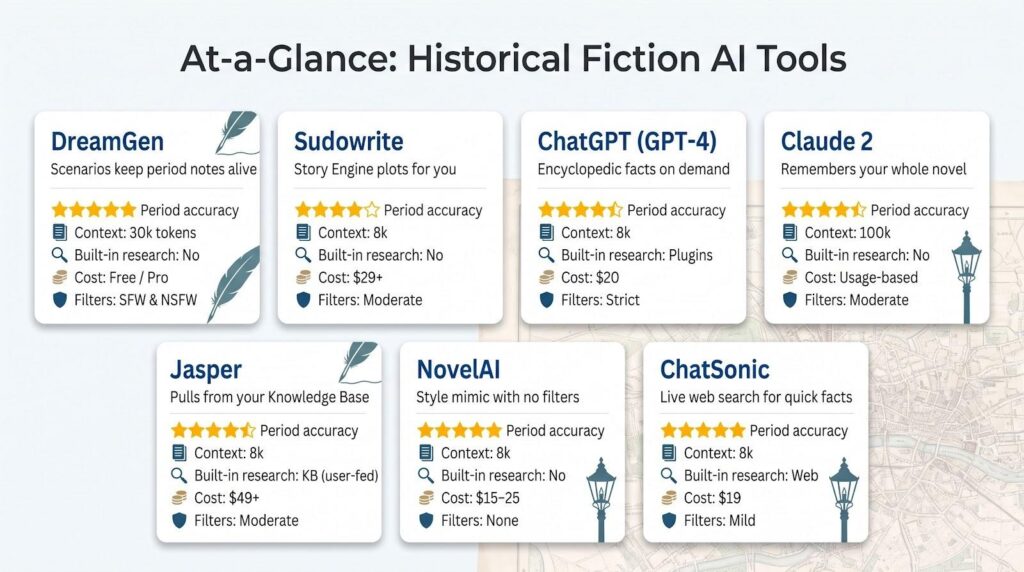
| Tool | Stand-out edge | Max context (tokens) | Period accuracy score | Built-in research | Monthly cost* | Filter strictness |
| DreamGen | Scenarios keep period notes alive | 30 000 | ★★★★★ | No | Free / Pro | SFW & NSFW |
| Sudowrite | Story Engine plots for you | 8 000 | ★★★★☆ | No | $29+ | Moderate |
| ChatGPT (GPT-4) | Encyclopedic facts on demand | 8 000 | ★★★★☆ | Plugins | $20 | Strict |
| Claude 2 | Remembers your whole novel | 100 000 | ★★★★½ | No | Usage-based | Moderate |
| Jasper | Pulls data from your Knowledge Base | 8 000 | ★★★★ | Yes (user-fed) | $49+ | Moderate |
| NovelAI | Style mimic with no filters | 8 000 | ★★★★ | No | $15-25 | None |
| ChatSonic | Live web search for quick facts | 8 000 | ★★★★ | Yes (web) | $19 | Mild |
*Prices reflect July 2026 public tiers and can change, so check each site before subscribing.
Conclusion
One glance should tell you: if you crave long-term memory, go Claude; if you need total freedom, pick NovelAI; and if pennies matter, look closely at ChatSonic’s GPT-4 bundle.
Keep this chart handy as you test-drive. Real drafting will reveal which strengths actually save you hours on the page.
Frequently Asked Questions
Why do so many AIs slip modern slang into period scenes?
Large language models train on oceans of present-day internet text. Researchers found they still lean modern even after “historical” fine-tuning, so anachronisms leak unless we police the prose.
Is it legal to publish a novel that contains AI-generated passages?
Yes. Copyright offices in the US and UK say you own the text as long as you direct and edit the output. Treat the AI as a drafting assistant, not the sole author, and you remain the rights holder.
Do I have to tell Amazon KDP I used AI?
KDP asks you to tick a disclosure box only if the content is entirely machine-generated with no human revision. If you edit heavily—which every historical writer should—you can list the book as “AI-assisted” and move on.
Which tool is cheapest for marathon drafting?
ChatSonic’s GPT-4 plan delivers the lowest cost per thousand words today, while NovelAI offers unlimited tokens for a flat fee. Writers on Reddit still grumble that Sudowrite’s cap runs out shockingly fast for novelists.
Which one gives me the deepest historical facts?
ChatGPT (GPT-4) wins on raw knowledge, especially if you add the browsing plugin. Industry reviewers consistently note its extensive historical data and dialogue capability.
Can these tools help with sensitive, era-accurate language?
DreamGen supports both SFW and NSFW content (though its public scenario library is SFW only), and NovelAI imposes almost no filters, leaving word choice to you. ChatGPT and Jasper follow stricter policies; expect them to soften or refuse certain slurs or graphic details.
What’s the safest workflow to avoid factual blunders?
Draft in your preferred AI, then run quick fact checks in ChatGPT or ChatSonic with live web. Finally, verify dates and terminology against primary sources or reputable history texts before locking the manuscript.